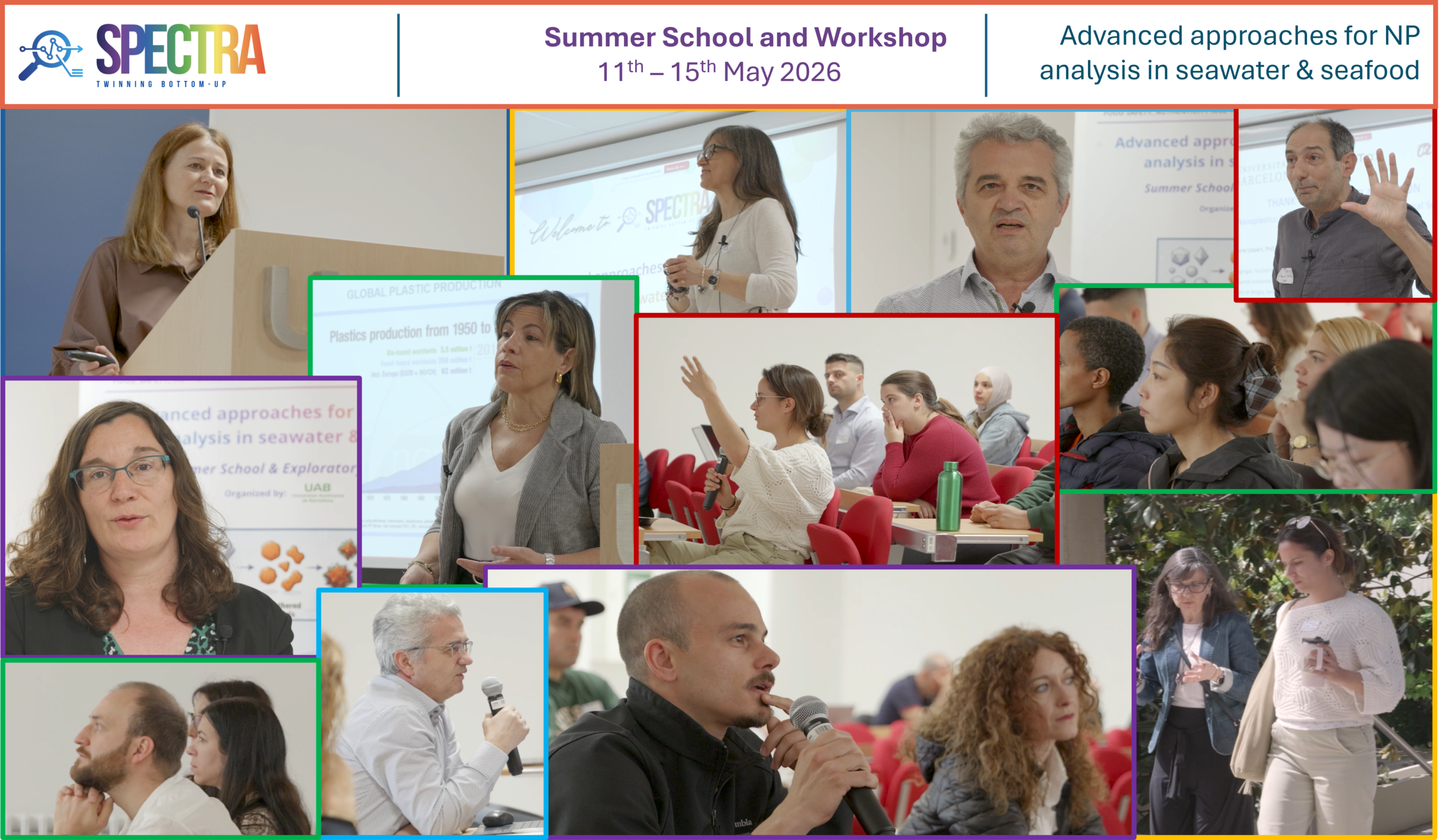
For five days in May, the Edifici C of the Facultat de Ciències at the Universitat Autònoma de Barcelona belonged to the nanoplastics community. Master’s and PhD students, early-career scientists, technical staff, senior researchers and industry specialists travelled in from across Europe, and joined online from further afield, to tackle one of analytical chemistry’s hardest problems: how do we detect, characterise and make sense of particles so small, in matrices as complex as seawater and seafood?
The answer, as the week unfolded, is that nobody does it alone. The SPECTRA Summer School (SS2, 11–13 May) and Exploratory Workshop (WS2, 14–15 May) were designed to bring together the people, the instruments and the conversations that make this kind of science possible. Hosted by the Group of Separation Techniques in Chemistry (GTS-UAB) and coordinated within the wider SPECTRA Twinning project led by Prof. Dimitra Lambropoulou at the Aristotle University of Thessaloniki, the events achieved precisely that.
The full video of the week, including highlights of the sessions and short interviews with several of the speakers, is now available on the SPECTRA project website and YouTube channel. We hope it conveys some of the atmosphere as well as the science.
Day 1: Why nanoplastics are not just smaller microplastics
The Summer School opened with a welcome from Prof. Dimitra Lambropoulou, who placed the week’s work firmly at the intersection of water quality, food safety and human health: the three areas that SPECTRA was established to strengthen across its partner institutions.
From there, Dr Montserrat López-Mesas (GTS-UAB) walked participants through the fundamentals. Where do micro- and nanoplastics come from, how do they behave in the environment, and why is sampling and sample preparation so much more difficult than the words suggest? Dr Ethel Eljarrat (IDAEA-CSIC) followed with a sobering picture of the more than ten thousand chemical substances associated with plastics, over two thousand of them flagged for environmental or human health hazard, and the bioaccumulation, biomagnification and maternal-transfer routes by which they reach us.
Dr Jordi Sierra Llopart (Universitat de Barcelona) traced the journey of nanoplastics from environmental sources into biological systems, and Dr Janja Vidmar joined online from the Jožef Stefan Institute in Ljubljana to address the analytical and conceptual challenges of detecting nanoparticles and nanoplastics in food matrices. Prof. Alba Hernández Bonilla (UAB), who coordinated the EU PLASTICHEAL project, closed the day with an overview of cytotoxicity, mechanisms and the gaps that remain in toxicological assessment.
A recurring message ran through the day. Nanoplastics are not just smaller versions of a familiar pollution problem. Their size, behaviour, chemistry and interaction with living systems make them genuinely difficult to sample, measure and interpret, and that is precisely why scientific capacity-building matters.
Day 2: Seeing the invisible
If Day 1 asked why, Day 2 asked how. How do you actually see, identify and characterise particles this small in matrices this complex?
There is no single answer. Modern nanoplastics analysis depends on careful combinations of techniques, with chemical imaging, microscopy, mass spectrometry and X-ray scattering each revealing a different part of the picture. Fernando Tobalina (Agilent Technologies) opened with LDIR chemical imaging and ICP-MS as a high-throughput route to identifying and quantifying microplastics and small particles. Dr Michael Soll (Frontier Laboratories) followed with Pyrolysis-GC/MS, covering fundamentals, sample preparation, instrumental setup, standards, limits of detection and how the technique complements spectroscopic methods.
Dr Iris H. Valido (GTS-UAB) then took participants through the comparative roles of SEM, TEM and confocal microscopy for nanoplastics work, with welcome candour about sample preparation challenges, contamination risks and the artefacts that can mislead. The session moved straight into a guided visit to the UAB Microscopy Service, where slides and lecture-room theory met real instruments and real workflows.
The afternoon closed with Dr Eduardo Solano (ALBA Synchrotron) on the structural characterisation of nanoplastics by SAXS/WAXS, showing how X-ray scattering at the nanoscale can reveal polymer structure, crystallinity, degradation and environmental ageing.
And then, in a quieter register but no less valuable, came the Science Café: Nanoplastics unfiltered: big questions on small particles (and coffee), facilitated by Dr Gustavo Pérez (GTS-UAB). The students of the Facultat de Ciències at UAB brought the discussion to life with their questions and energy. As one participant put it afterwards, it was the kind of exchange where you stop performing expertise and start actually thinking out loud, which is when the most interesting things tend to happen.
Day 3: From slides to instruments
Day 3 turned to counting, sizing, separating and fingerprinting. Dr Pablo Palomino (IESMAT) introduced Dynamic Light Scattering and then Nanoparticle Tracking Analysis, covering not only how each technique works but the practical factors (sample preparation, salinity, surfactants, natural organic matter, camera and laser settings) that determine data quality and the artefacts that can quietly mislead an interpretation. Dr Francisco J. López (IESMAT) followed with Field-Flow Fractionation, showing how multi-detector setups (MALS, UV, RID) can extend what FFF tells us about size and composition in complex matrices.
Dr Niklas Luhmann (Invisible-Light Labs) closed the lecture programme with NEMS-FTIR, a nanomechanical infrared approach that combines nanoelectromechanical resonators with the broadband capabilities of conventional FTIR to push chemical characterisation of nanoplastics down to the picogram level.
The afternoon then moved from lecture room to laboratory bench. Three hands-on stations, DLS and NTA with IESMAT and infrared spectroscopy with Bruker, gave participants live instrument time, with short real-workflow demonstrations and the chance to put questions directly to the specialists running each station.
A clear message emerged from the day. Detection limits, sample preparation and matrix effects influence every measurement. Choosing the right technique is only half the work. Interpreting what it tells you is the other half.
Days 4 and 5: From research gaps to a roadmap
With the Summer School closed, the Exploratory Workshop (WS2) opened on Thursday 14 May with a deliberate shift of gears. Where SS2 had built capacity, WS2 was designed to translate that capacity into strategy: research gaps, risk assessment, standardisation, funding and consortia-building.
Dr Irene Barguilla (Mutagenesis group, UAB) opened with an expert talk on the real gaps in micro- and nanoplastics research, drawing on the CUSP cluster to sharpen the discussion that followed. The round table, chaired by Dr Montserrat López-Mesas, with Dr Dimitra Lambropoulou (AUTH), Dr Irene Barguilla (UAB), Dr Lara Cioni (IDAEA-CSIC) and Dr Isabel Forner-Piquer (ICM-CSIC), worked through the practical barriers and possible solutions across risk assessment, sampling, real-sample analysis and standardisation.
In the afternoon, participants travelled to the ALBA Synchrotron for a first-hand look at one of Europe’s most significant scientific infrastructures, exploring its beamlines and the role of synchrotron-based techniques in advanced materials and environmental research.
Day 5 turned to the future. Irina Vitchinka (SiTeS) mapped the Horizon Europe and Widening funding picture, the timelines, the calls and the practical question of how to position WS2’s insights inside a competitive proposal. The closing session, moderated by Dr Gustavo Pérez (GTS-UAB), drew the threads together: from identified research gaps to concrete project concepts, with shared roles and next steps for collaboration. The workshop closed at lunchtime on Friday with the rare and valuable sense that something genuinely actionable had emerged.
Acknowledgements: it takes a community
Events on this scale do not happen by accident, and there are a great many people to thank.
To the academic speakers, Dr Montserrat López-Mesas, Dr Iris H. Valido, Dr Ethel Eljarrat, Dr Jordi Sierra Llopart, Dr Janja Vidmar, Prof. Alba Hernández Bonilla, Dr Eduardo Solano, Dr Irene Barguilla, Dr Lara Cioni, Dr Isabel Forner-Piquer and Dr Gustavo Pérez: thank you for the generosity with which you shared your work and the patience with which you fielded the questions that followed.
To our industry and technology partners, who bridged the gap between theory and real-world instrumentation: Pablo Palomino and Francisco J. López of IESMAT, Fernando Tobalina of Agilent Technologies, Niklas Luhmann of Invisible-Light Labs, and Michael Soll of Frontier Laboratories. A special thank you to the IESMAT team for their exceptional support throughout the organisation of the Summer School, and in particular to B. Sampedro. Thanks too to A. Montasell of Bruker for the collaboration on the hands-on practicum, and to D. Colas (Agilent Technologies) and L. Rovira (Alfaquimia) for their help in connecting us with the right industrial experts. And of course, our thanks to the ALBA Synchrotron team for hosting the WS2 visit.
To our campus partners at UAB: I. Villaroya and the SAQ for the use of their equipment during the practicum, and the SMiDRX team for hosting our participants and providing such helpful guidance during their facility visit.
To M. Fernandez, J. Senyé and C. Cazorla, who handled the logistics so capably that most of us hardly noticed they were doing it, which is, of course, the highest praise for that kind of work.
To Irina Vitchinka of SiTeS for the funding-landscape session, and to Prof. Dimitra Lambropoulou at AUTH, project coordinator, for the leadership and vision that hold SPECTRA together.
And finally, to the participants. To those who travelled to Barcelona and to those who joined online from across the globe: thank you for your questions, your engagement, your stamina across some long days, and the conversations that spilled out of the sessions into the coffee breaks and corridors. Particular thanks to the students of the Facultat de Ciències at UAB, whose Science Café contributions reminded everyone that the future of this field is in very capable hands.
And finally…
These events are fundamentally what Twinning projects like SPECTRA are about: building bridges between institutions, sharing expertise across borders, and growing research capacity together. The five days in Barcelona are over but the collaborations they fostered are very much under way.