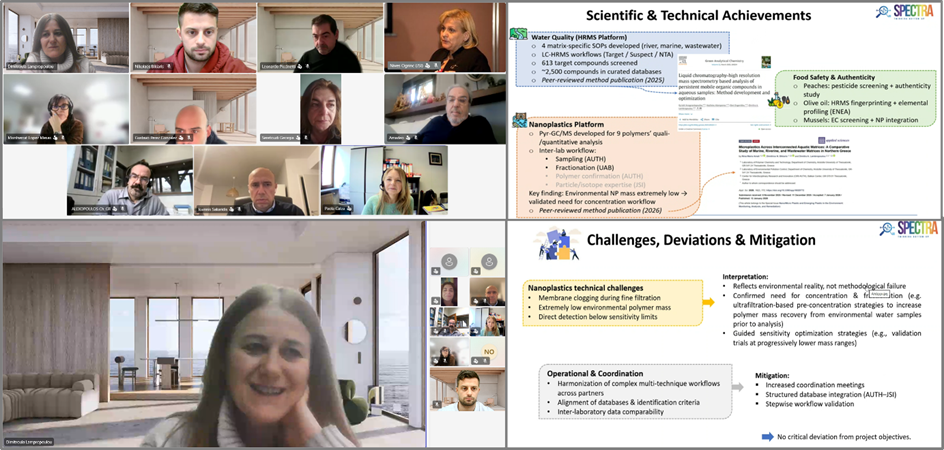
On 17 February 2026, the SPECTRA consortium convened its External Advisory Board for a hybrid strategic meeting focused on scientific progress, methodological challenges, and the continued strengthening of research capacity in Water Quality and Food Safety, Authenticity and Traceability.
SPECTRA is designed not only to advance analytical science, but also to enhance research excellence and international integration at Aristotle University of Thessaloniki within the European Research Area. The Advisory Board meeting provided an important opportunity to test progress against this ambition.
SPECTRA Project Coordinator, Prof. Dimitra Lambropoulou and partners from AUTH, UAB, JSI and SITES presented developments across the three core case studies, alongside contributions from distinguished Advisory Board members:
- Dr Ioannis Sakaridis, ELGO DIMITRA
- Prof Amadeo Fernández Alba, University of Almería
- Dr Georgia Seretoudi, EYATH Thessaloniki Water Supply and Sewage Company
- Prof Paola Calza, University of Torino
- Dr Charis Alexopoulos, General Chemical State Laboratory
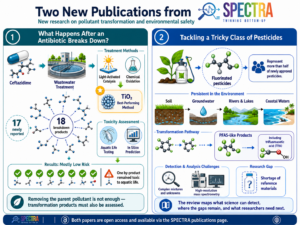
In water quality, progress was reported on high resolution mass spectrometry workflows for target, suspect and non-target screening in river and marine systems. The identification of transformation products of emerging contaminants was discussed in depth, with valuable input on marine matrix complexity and database expansion. These exchanges directly support SPECTRA’s objective of embedding robust, harmonised analytical approaches at AUTH.
Nanoplastic analysis was recognised as a technically demanding frontier. The Board provided practical guidance on detection limits, contamination control, sample preparation automation, tracer strategies and complementary LCMS approaches. The discussion reflected the project’s commitment to building durable analytical expertise rather than pursuing isolated results.
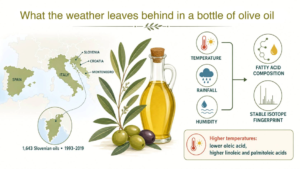
Food authenticity prompted strong interest in the integration of chemical fingerprinting, isotope ratio techniques and molecular DNA based methods. Case studies on olive oil, peaches and mussels illustrated how combining complementary analytical frameworks can enhance traceability and fraud detection while broadening institutional competence.
Across all topics, the Advisory Board emphasised methodological validation, inter laboratory collaboration and alignment with emerging regulatory priorities. The feedback will inform upcoming mobility activities, method optimisation, and the further consolidation of AUTH’s research infrastructure and international networks.
The consortium thanks the Advisory Board for their constructive engagement and for contributing to SPECTRA’s dual mission of advancing scientific knowledge and strengthening long term research capacity in Greece within a European context.