Quite a lot as it happens! A bottle of extra virgin olive oil contains more than the product of a particular olive variety, orchard and harvest. It also carries a chemical record of the conditions in which the olives grew: the heat, the rain, the humidity and the number of exceptionally hot days.
A new study published in Food Chemistry has examined how this record changes over time, and what it could tell us about olive oil quality, origin and authenticity as the Mediterranean climate becomes warmer.
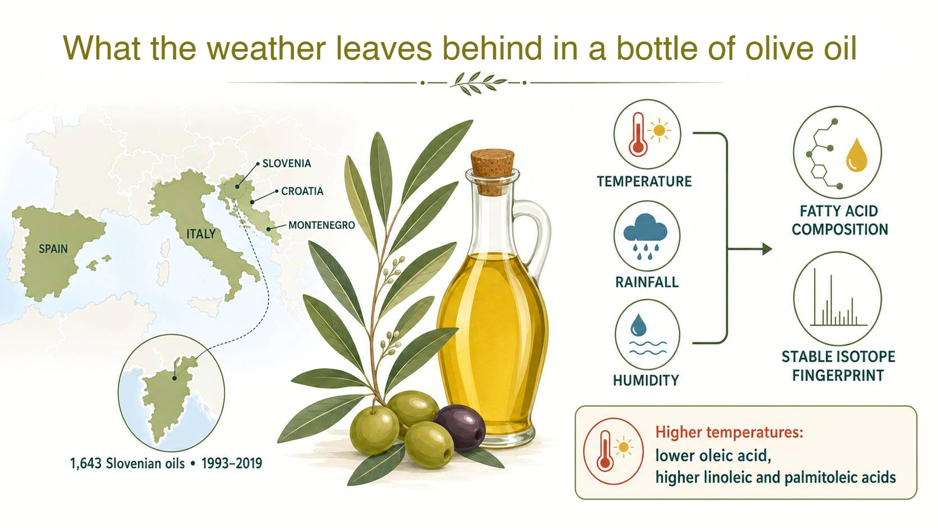
The research, supported by the SPECTRA project, drew on an unusually extensive collection of 1,643 authentic Slovenian extra virgin olive oil samples produced between 1993 and 2019. The researchers examined the oils’ fatty acid composition and, for selected harvest years, their stable isotope signatures.
Stable isotopes are naturally occurring forms of elements such as carbon, hydrogen and oxygen. Their proportions vary according to environmental conditions, leaving a measurable chemical fingerprint in the oil. Analysed carefully, that fingerprint can provide clues about where an oil was produced and the climate in which its olives were grown.
Heat changes the composition of the oil
The clearest finding was the relationship between temperature and fatty acids. Higher temperatures were associated with lower levels of oleic acid, the principal fatty acid in olive oil, and higher levels of linoleic and palmitoleic acids.
This has implications beyond the laboratory. Fatty acid composition is one of the criteria used to assess olive oil quality and purity, including the detection of adulteration with other vegetable oils. If climate conditions alter that composition, they may also complicate the interpretation of established regulatory thresholds.
The oil’s isotopic fingerprint told another chapter of the story. Oxygen isotope values in the Slovenian samples were influenced mainly by the frequency of hot days and relative humidity, while hydrogen isotope values showed a strong relationship with temperature.
To explore the influence of geography, the researchers also studied oils from Croatia, Italy, Montenegro and Spain. The Spanish samples, produced under the warmest and driest conditions in the comparison, had significantly higher carbon, hydrogen and oxygen isotope values. Oils from cooler and wetter regions showed lower values.
The analysis could distinguish Spanish and Italian oils from those produced in the Balkan region, although the separation between Slovenian, Croatian and Montenegrin oils was less clear. Olive variety was not fully controlled in the study and may account for some of the differences, while isotope measurements were available for a more limited selection of samples. These are important caveats, particularly when the findings are considered for future traceability systems.
A changing climate and a moving baseline
Olive oil is among Europe’s most economically valuable food products, but it is also frequently adulterated. Analytical methods that help verify its origin and composition therefore have an important role in protecting producers, consumers and regional food identities.
The difficulty is that the chemical baseline is not fixed. As temperatures rise and rainfall patterns change across the Mediterranean, authentic olive oils may begin to present differently from the oils on which existing reference ranges and authentication models were built.
This is where long-term datasets become particularly valuable. Rather than offering a snapshot from a single season, the Slovenian collection allowed the researchers to examine nearly three decades of variation and begin separating the influence of weather from the many other factors that shape an oil.
The study closely reflects SPECTRA’s work on food safety, quality, traceability and authenticity. It also demonstrates the relevance of stable isotope analysis, one of the specialist techniques being shared through the project’s training and research programme.
The next challenge will be to build larger datasets that cover more harvests, regions and olive varieties. A bottle of extra virgin olive oil may already reveal a surprising amount about its past. Making sense of that record under a changing climate will require the reference books to change with it.
Publication: Neri Bonciani, Marjeta Mencin, Doris Potočnik, Claudio Natali, José Manuel Moreno-Rojas, Milena Bučar-Miklavčič and Nives Ogrinc, “Impact of meteorological conditions on fatty acid composition and isotopic signatures in Slovenian extra virgin olive oil: A long-term study”, Food Chemistry, Volume 525, 2026, 150369.
Read the open-access publication
This research received support from the European Union’s Horizon Europe research and innovation programme through the SPECTRA project under Grant Agreement No. 101158453.