The 9th Environmental Conference of Macedonia (ECOMAC 2026), held in Thessaloniki on 8 and 9 May 2026, provided SPECTRA with one of its most substantial conference platforms of the year. The event, which takes place every three years and brings together researchers, policymakers, institutions and environmental professionals working on innovative and sustainable environmental solutions, saw the SPECTRA team contribute across the programme with a keynote lecture, multiple oral presentations and poster sessions, and the announcement of a new peer-reviewed publication.
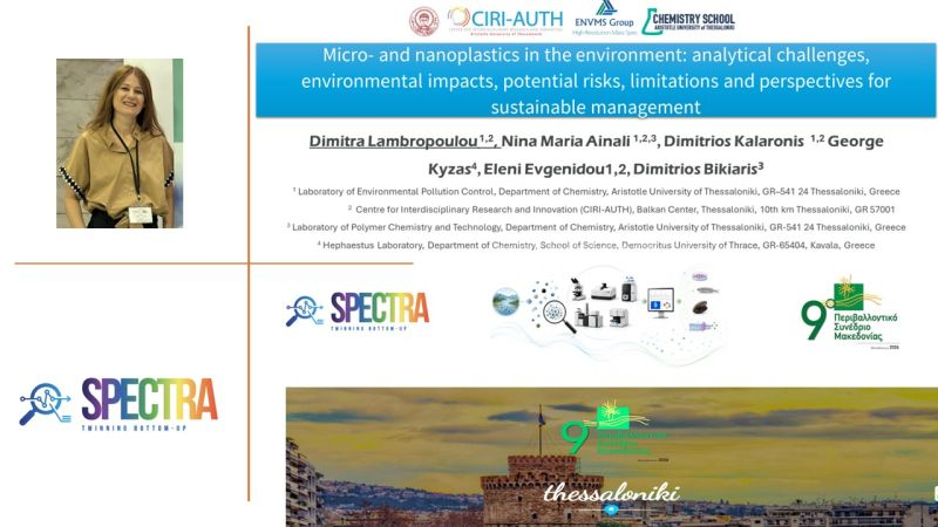
Keynote: Micro- and Nanoplastics in the Environment
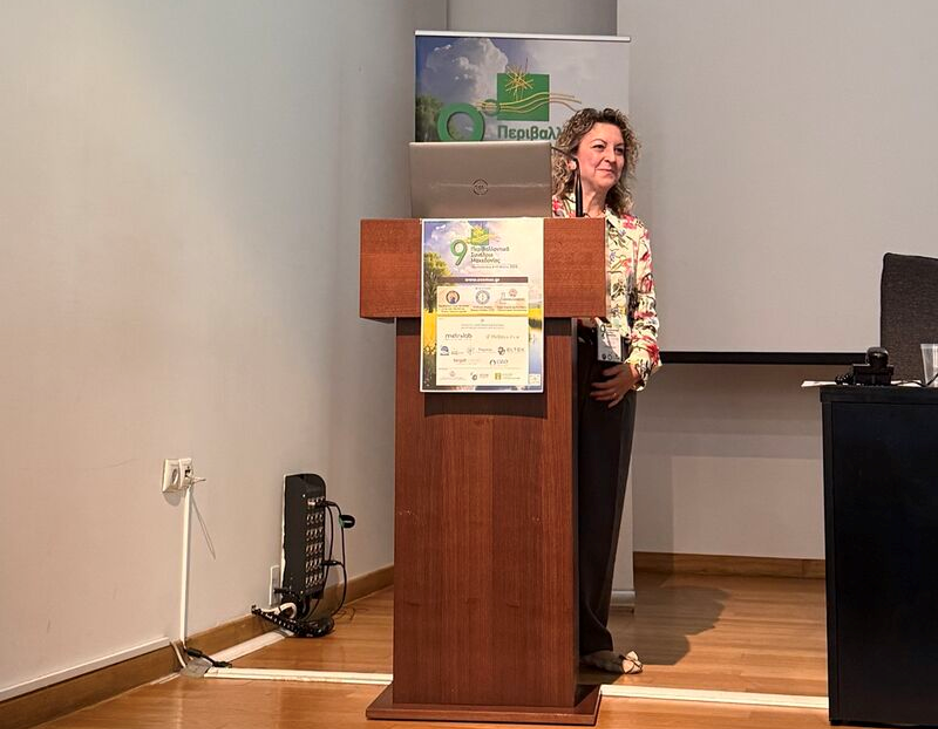
Prof. Dimitra Lambropoulou opened SPECTRA’s participation with a keynote lecture on “Micro- and nanoplastics in the environment: analytical challenges, environmental impacts, potential risks, limitations and perspectives for sustainable management.” The lecture set out the state of the field with clarity and ambition, addressing the analytical challenges of detecting and characterising micro- and nanoplastics across environmental matrices, their occurrence and documented environmental impacts, the current limitations in risk assessment that make regulatory progress difficult, and the future perspectives for sustainable environmental management and monitoring that SPECTRA’s work is helping to shape.
The keynote reflected both the depth of the analytical expertise the SPECTRA team has built and the project’s commitment to connecting that expertise with the broader environmental science and policy community. ECOMAC, as one of the most significant regional environmental conferences, was an ideal setting for that contribution.
ESR Presentations: From Antibiotics to PFAS to River Fingerprinting
SPECTRA’s early-stage researchers contributed four further presentations to the ECOMAC programme, each reporting on distinct strands of the project’s analytical work.
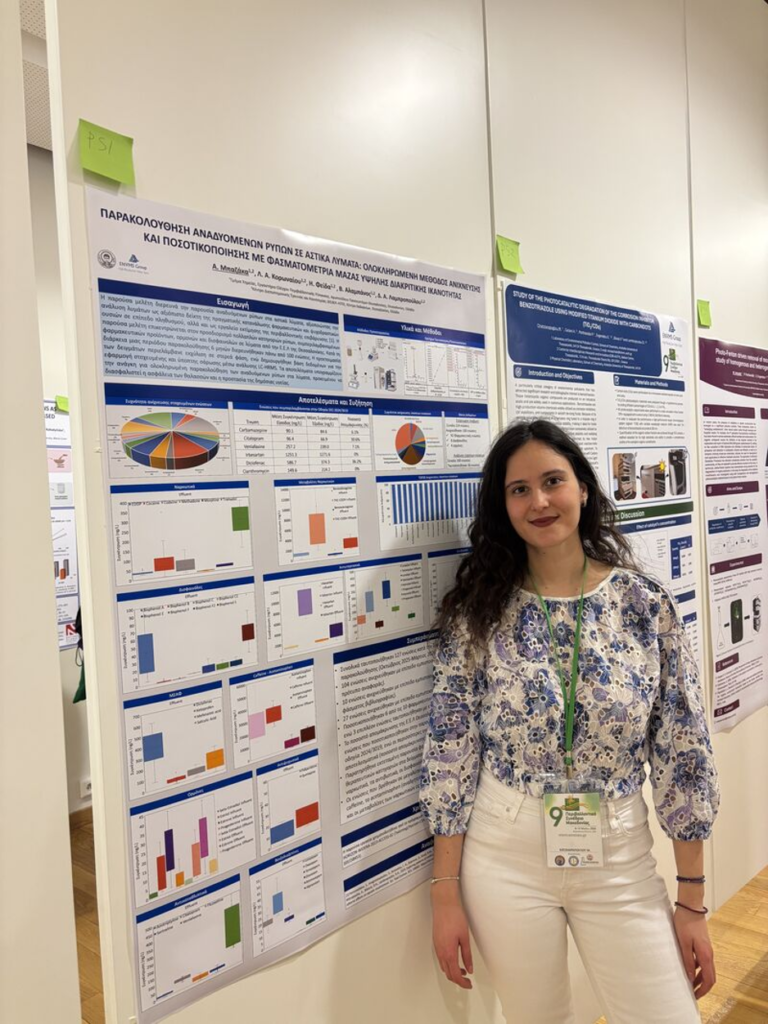
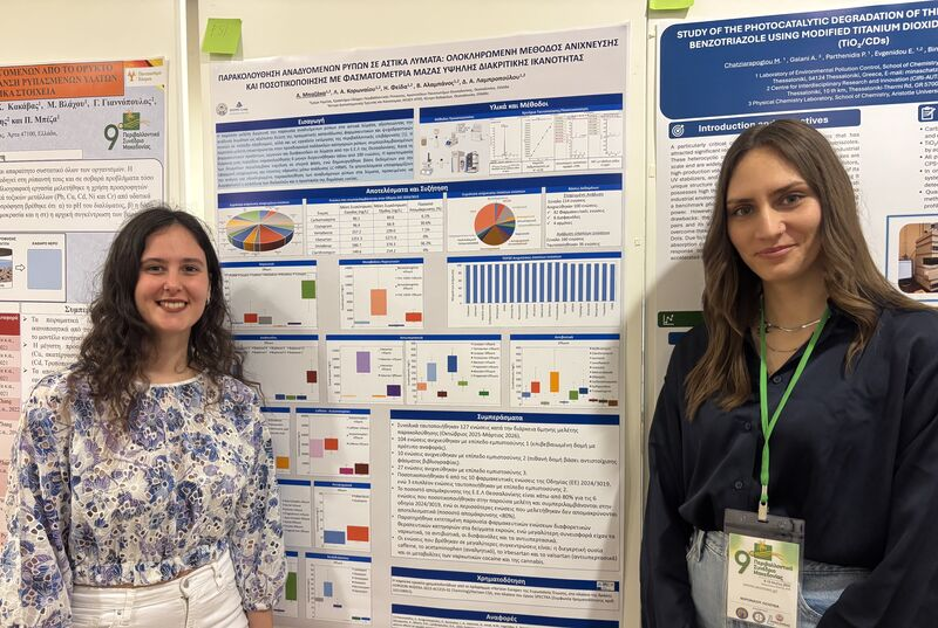
Dr Eleni Evgenidou delivered an oral presentation on “Monitoring of Transformation Products and Toxicity During the Photocatalytic Degradation of Ceftazidime via Advanced Oxidation Processes”, presenting research on the degradation pathways of the antibiotic ceftazidime under photocatalytic treatment and the ecotoxicological implications of the transformation products generated. Ilektra Feida presented an oral contribution on the validation of an analytical methodology for determining per- and polyfluoroalkyl substances (PFAS) in soil samples using liquid chromatography coupled to high-resolution mass spectrometry, reporting on method performance parameters including accuracy, precision, recovery, reproducibility and sensitivity. Anastasia Bazaka presented research on monitoring emerging pollutants in municipal wastewater using a combination of target and suspect analysis with high-resolution mass spectrometry, investigating the occurrence of a broad range of emerging contaminants in the wastewater of Thessaloniki. And Lida Koronaiou presented a poster on machine-learning-based river fingerprinting by ICP-MS, combining multi-element geochemical analysis of the Aliakmonas and Pinios river basins with explainable machine learning to investigate geochemical signatures and assess water quality, a study that attracted considerable interest for its innovative combination of environmental geochemistry and interpretable AI.
New Publication: Beyond Degradation
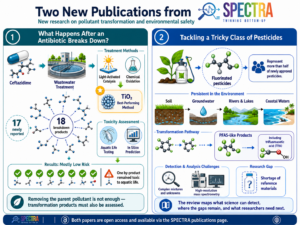
ECOMAC also provided the occasion to highlight a new peer-reviewed publication from the SPECTRA team. The paper, “Beyond degradation: LC-HRMS based tracking of transformation products and toxicity during photocatalytic removal of ceftazidime via advanced oxidation processes”, published in ScienceDirect, investigates the degradation of ceftazidime using heterogeneous and homogeneous photocatalytic systems, applying LC-HRMS to trace transformation pathways and products and ECOSAR-based predictions to assess the potential ecotoxicity of the substances generated. The work was authored by Eleni Evgenidou, Panagiotis Pavlidis, Androniki Rapti, Lida Koronaiou, Vasileios Alampanos and Prof. Dimitra Lambropoulou, and was financially supported by the European Union’s Horizon Europe programme under the SPECTRA project (Grant Agreement No. 101158453).
The paper reflects the project’s commitment to going beyond detection and degradation to understand what happens to contaminants as they are transformed, and what the ecotoxicological implications of those transformation products might be. That question, what comes after the parent compound, is one of the most important and least well understood in environmental analytical chemistry, and SPECTRA’s contribution to answering it is a significant one. SPECTRA thanks the ECOMAC 2026 organising committee, and in particular Dimitrios A. Giannakoudakis, Ioannis Lykakis and Vasilios Koulos, for the excellent organisation of the conference and for the opportunity to contribute across its programme.