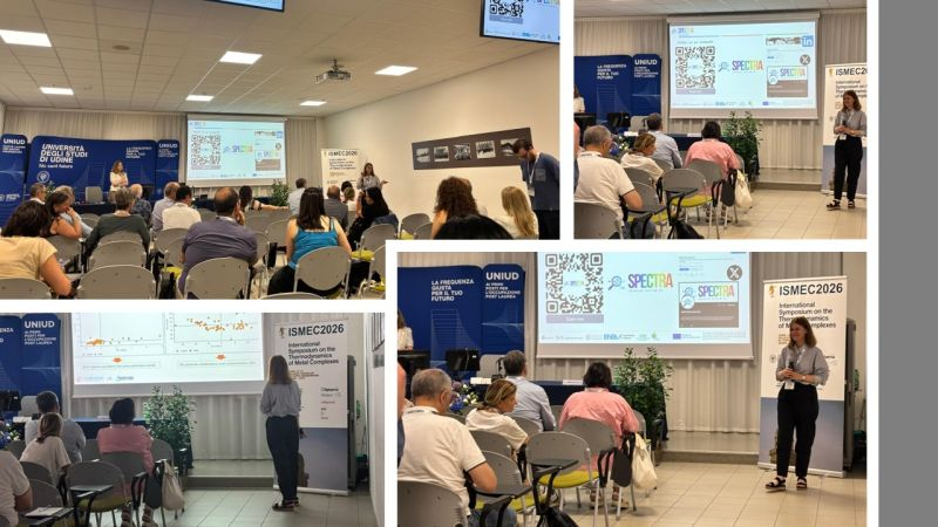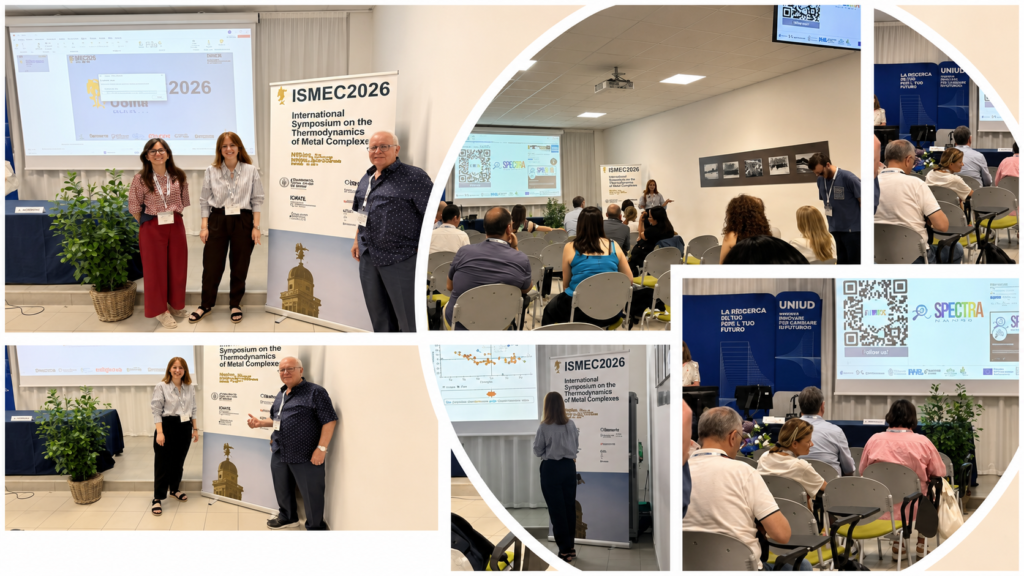
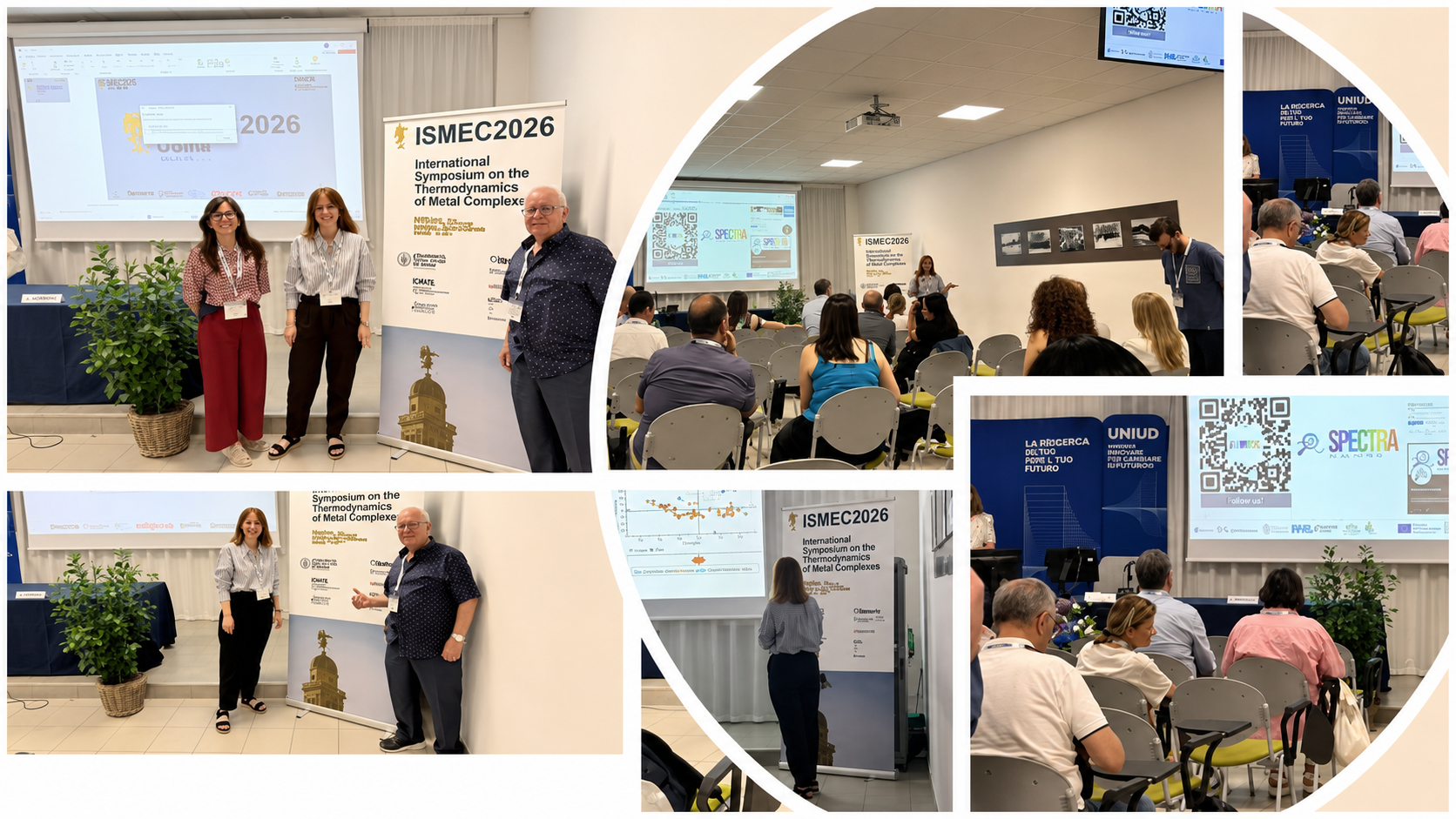
From 15 to 18 June 2026, the city of Udine hosted the International Symposium on the Thermodynamics of Metal Complexes (ISMEC 2026), organised by the Universita degli Studi di Udine. The symposium brought together leading researchers working on critical raw materials, rare earth element recovery, sustainable separation technologies and circular economy solutions, a scientific community with strong thematic connections to SPECTRA’s own research agenda.
SPECTRA Project Coordinator Prof. Dimitra Lambropoulou attended the symposium and delivered a keynote lecture entitled “Targeted and Suspect LC-HRMS Strategies for Screening Multiclass Micropollutants and Their Transformation Products in Environmental and Food Samples”. The lecture drew on the analytical work being advanced within SPECTRA, presenting the project’s approaches to high-resolution mass spectrometry-based screening for emerging contaminants and their transformation products across environmental and food matrices. The audience at ISMEC, with its strong grounding in separation science, sustainable chemistry and materials recovery, provided a particularly engaged and technically sophisticated context for these discussions.
Beyond the scientific programme, the symposium offered valuable opportunities to strengthen existing partnerships and explore new ones. Prof. Lambropoulou had the opportunity to connect with Prof. Montserrat Lopez-Mesas and Prof. Manuel Valiente from the Universitat Autonoma de Barcelona, both SPECTRA partners, reinforcing the collaborative ties that have been central to the project’s work on nanoplastics analysis and separation techniques. She also met with Prof. Andrea Melchior, Coordinator of the FREECOVER Project, and Prof. Marilena Tolazzi, opening up new avenues for synergy between SPECTRA and complementary European research initiatives in environmental and analytical science.
Events like ISMEC illustrate something that SPECTRA has consistently demonstrated in practice: that the most productive scientific exchanges happen at the boundaries between disciplines and communities. Bringing together researchers working on metal complexes, rare earth recovery and sustainable separation with those advancing analytical monitoring of emerging contaminants generates precisely the kind of cross-disciplinary dialogue that can open unexpected research directions.
Prof. Melchior, one of the ISMEC 2026 organisers, reflected on the occasion afterwards, noting that it was an honour to host such an outstanding speaker and expressing enthusiasm for future collaboration. It was, as Prof. Lambropoulou noted in return, a privilege to contribute to an event of such scientific quality.