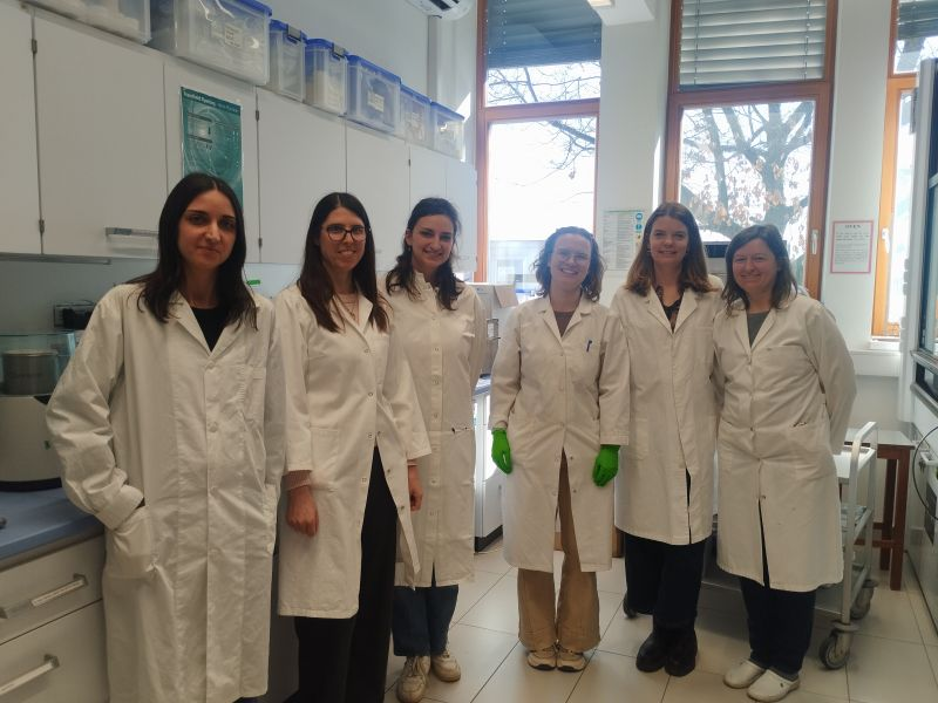
Two early-stage researchers from the SPECTRA project at the Aristotle University of Thessaloniki travelled to Ljubljana in early March for the latest in SPECTRA’s ongoing programme of mobility visits to the Jozef Stefan Institute (JSI), one of Europe’s leading multidisciplinary research centres. The visits, running concurrently across the same week, placed Ilektra Feida and Lida Koronaiou in two different research environments within JSI, each pursuing a distinct but complementary strand of SPECTRA’s analytical programme.
Ilektra Feida: Isotope Ratio Mass Spectrometry with Prof. Nives Ogrinc
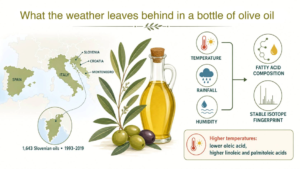
Ilektra, a PhD candidate at AUTH, spent the week working in the laboratory of Prof. Nives Ogrinc at JSI’s Reactor Center, gaining hands-on experience with Isotope Ratio Mass Spectrometry (IRMS). IRMS is a powerful analytical technique with important applications in food authenticity and environmental research, enabling the verification of geographical origin and the detection of adulteration through the precise measurement of stable isotope ratios in biological and environmental samples.
Over the course of the week, Ilektra worked through the full sample preparation workflow for IRMS analysis, including the processing of biological samples and their preparation for freeze-drying prior to instrumental analysis. Alongside the practical laboratory work, she attended presentations from colleagues within the JSI group on current environmental research projects, including work on micro- and nanoplastics in agricultural systems and studies of atmospheric mercury behaviour and transformation. The combination of hands-on technique development and exposure to the broader research context made for an especially rich week of learning.
Lida Koronaiou: Machine Learning and FAIR Data with Prof. Tome Eftimov
Lida, a PhD student at AUTH, spent the same week working with Prof. Tome Eftimov and Prof. Barbara Korosic Seljak in JSI’s AutoLearn-SI group, exploring the integration of machine learning with complex analytical datasets relevant to food authenticity and environmental monitoring.
The hands-on sessions covered supervised and unsupervised machine learning methods, strategies for handling imbalanced datasets, and approaches for building reproducible analytical workflows. A significant part of the work also addressed the implementation of FAIR data principles, ensuring that research data generated within SPECTRA remain findable, accessible, interoperable and reusable within European research ecosystems. As open science requirements become increasingly central to Horizon Europe projects, building this kind of data management expertise within the research team is directly relevant to SPECTRA’s long-term impact.
What these visits represent
Mobility is one of the core mechanisms through which SPECTRA builds research capacity across its partner institutions. By placing early-stage researchers in leading European laboratories, the project gives them direct access to expertise, instrumentation and analytical approaches that complement and extend what is available at AUTH. The JSI visits in early March achieved precisely this: both Ilektra and Lida returned to Thessaloniki with strengthened practical skills, new collaborative relationships and a broader perspective on the scientific questions SPECTRA is working to answer.
Prof. Tome Eftimov expressed the warmth of the welcome at JSI simply: it is always a pleasure to host these visits, and the discussions they generate are genuinely inspiring for both sides. That sense of mutual benefit is what makes the twinning model work.