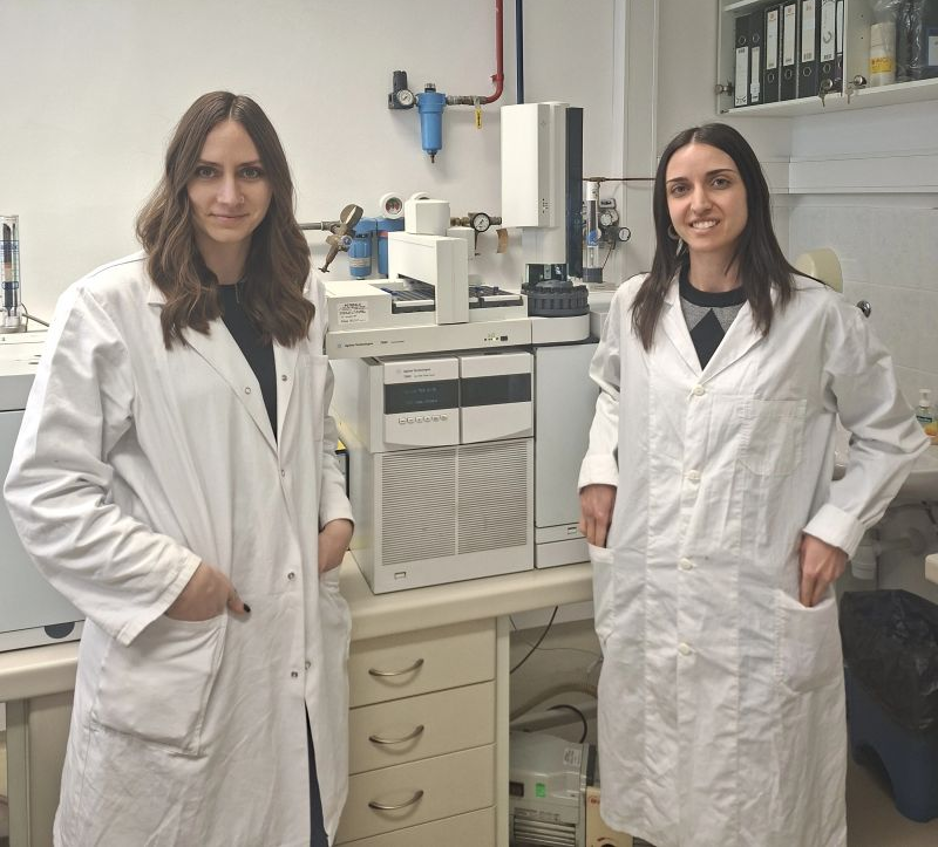
In the second week of March, Ilektra Feida and Lida Koronaiou returned to the Jozef Stefan Institute in Ljubljana for a second round of mobility visits, each building directly on the foundations laid during their first stay earlier in the month. Where the first visits had introduced new techniques and research environments, the second round went deeper: more hands-on instrument time, more complex analytical workflows and a wider view of the collaborative landscape between SPECTRA and JSI.
Ilektra Feida: Nanoplastics Analysis by spICP-MS with Dr Janja Vidmar
For her second mobility, Ilektra moved into a different laboratory within JSI, working with Dr Janja Vidmar on single-particle ICP-MS (spICP-MS), an advanced technique for the detection and characterisation of nanoparticles and nanoplastics at the individual particle level. The technique is directly relevant to SPECTRA’s work on nanoplastics in environmental and food matrices, and the opportunity to learn it hands-on from one of its leading practitioners was a significant step forward for Ilektra’s analytical development.
Over the course of the week, she worked through the full analytical workflow: from sample preparation for strawberry matrices through to instrumental analysis and the visualisation and interpretation of preliminary results. Dr Vidmar guided her through each stage, and by the end of the week Ilektra had completed real sample analysis and begun to develop the interpretive skills that turn raw spICP-MS data into meaningful scientific conclusions.
The visit also brought Ilektra into contact with the InPlasTwin project, a Horizon Europe initiative coordinated by Dr Vidmar that focuses on strengthening research capacity for micro- and nanoplastics analysis in environmental and food systems. The scientific connections between InPlasTwin and SPECTRA are strong, and observing the work carried out within both initiatives gave Ilektra a broader perspective on how collaborative European projects are collectively advancing this technically demanding field. InPlasTwin noted the synergy warmly, recognising that research mobility and cross-project exchange are key to creating long-term impact beyond individual projects.
She also had the opportunity to meet Prof. Ester Heath and tour her laboratory alongside Lida Koronaiou, who was conducting her own mobility in the same research group during the same week.
Lida Koronaiou: Environmental Chemistry and Analytical Integration with Prof. Ester Heath
Lida’s second mobility at JSI shifted from the machine learning focus of her first visit toward the analytical chemistry perspective, working with Prof. Ester Heath, Dr David Heath and Dr Eirini Andreasidou in JSI’s Environmental Sciences Department. The aim was to link the environmental monitoring data and the machine learning approaches explored in the first visit, strengthening the integration between advanced analytical techniques and data-driven methods for environmental and food-related datasets.
The week’s work focused on LC-MS/MS and GC-MS methods for the detection and characterisation of contaminants in environmental samples, with discussions and demonstrations covering analytical workflows, instrumentation and data interpretation strategies in environmental chemistry research. Dr Janja Vidmar also demonstrated spICP-MS nanoparticle analysis to Lida, giving her direct exposure to the same technique Ilektra was working with in depth, and creating a shared analytical reference point between the two researchers.
Lida also continued her engagement with FAIR data principles during the visit, exploring how the analytical workflows being developed within SPECTRA can be designed from the outset to produce data that is findable, accessible, interoperable and reusable, in line with Horizon Europe’s open science requirements.
A growing collaboration
Taken together, the two rounds of JSI mobility in March represented a substantial investment in the analytical and methodological development of SPECTRA’s early-stage researchers. By the end of the second week, both Ilektra and Lida had worked across multiple research groups within JSI, gained hands-on experience with a range of advanced techniques, and built the kind of working relationships with JSI colleagues that will support ongoing collaboration well beyond the formal mobility period. Prof. Dimitra Lambropoulou, SPECTRA project coordinator, has consistently emphasised that mobility is not a box to tick but a genuine mechanism for building the research capacity and international networks that define a successful twinning project. The March visits to JSI demonstrated exactly what that looks like in practice.