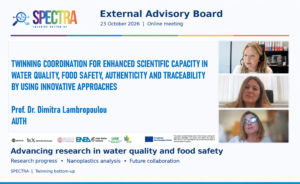
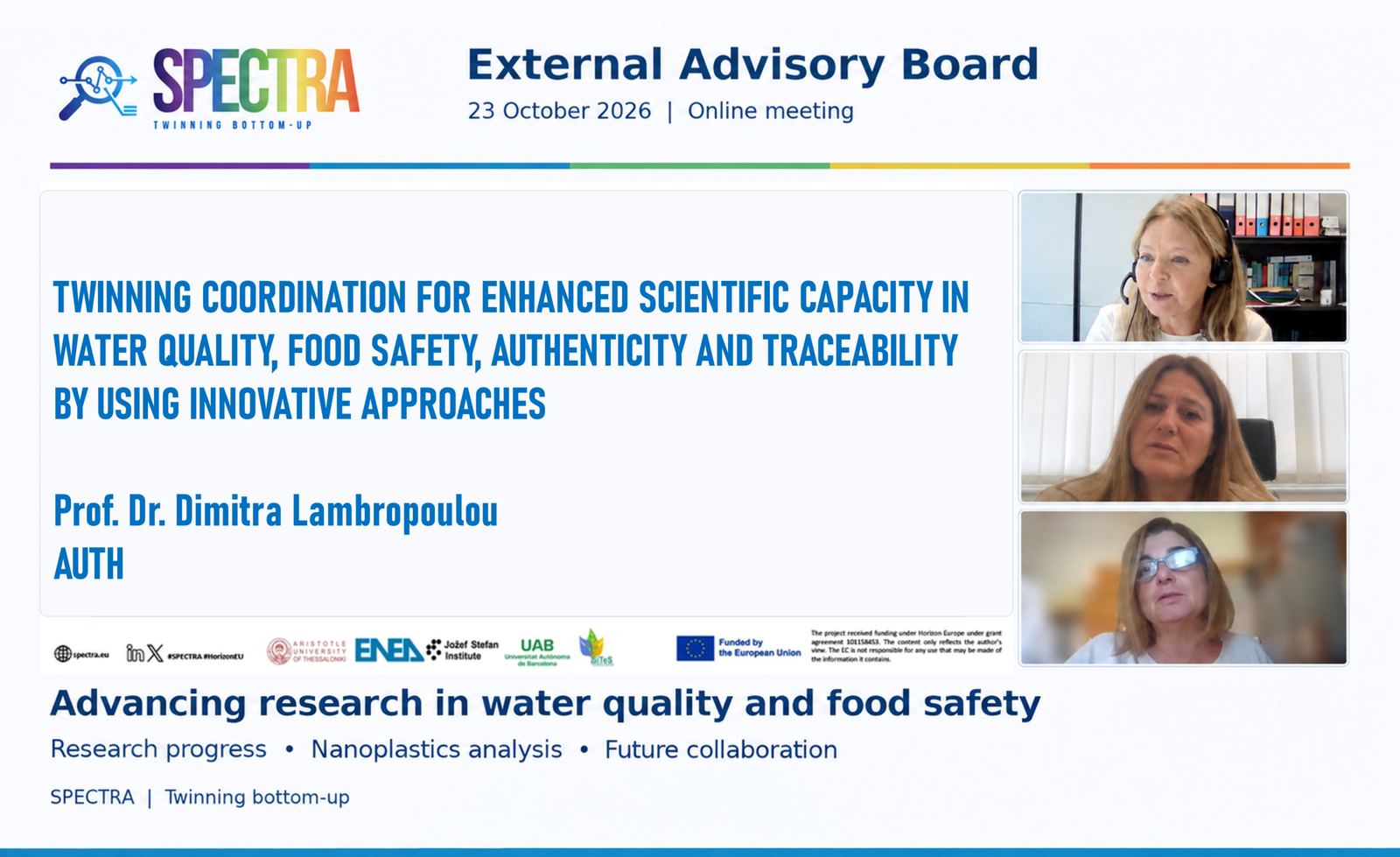
External Advisory Board members Prof. Dr Paola Calza (University of Torino) and Dr Georgia Seretoudi (Head of Management Water Facilities / Head of Direction Water Facilities, Thessaloniki Water Supply & Sewerage Co. SA) joined the SPECTRA team on 23 October 2026 to discuss research progress, practical challenges in nanoplastics analysis and opportunities for further collaboration.
Reliable analysis starts long before a sample reaches an instrument. Collecting enough water, preparing complex samples and choosing suitable methods all influence what researchers can detect and measure. These practical challenges were a central theme of SPECTRA’s online External Advisory Board meeting as the project enters its third and final year.
Prof. Dimitra Lampropoulou of Aristotle University of Thessaloniki (AUTH) presented progress across water quality, food safety, and food authenticity and traceability. Monitoring of different groups of water contaminants has been completed using targeted analysis, suspect screening and non-targeted approaches. Food-monitoring activities are also nearing completion, with a related article submitted to Food Chemistry.
Moving nanoplastics analysis forward
Nanoplastics remain a particularly demanding area, with challenges in sampling, sample preparation and the application of laboratory protocols to real samples.
AUTH and the Autonomous University of Barcelona (UAB) are working together on sample preparation and nanoplastics analysis. Some preparation protocols have been standardised, while validation and analytical work continue. The immediate priority is determining nanoplastics in water, with work on mussel samples envisaged in the coming months.
Prof. Dr Paola Calza offered to connect the team with a researcher working on nanoplastics characterisation, opening up an opportunity to exchange methods and specialist expertise.
Bringing methods into practical use
A recently initiated collaboration with a water utility highlighted the demands of practical monitoring. Discussions covered the collection of large drinking-water samples, the management of suspended solids and turbidity in raw and river water, and the preparation procedures needed before analysis can proceed.
This collaboration offers an opportunity to develop and validate methods under real water-monitoring conditions, helping researchers address challenges that are difficult to reproduce in the laboratory alone.
Building connections for the final year and beyond
The meeting also explored possible exchanges with a water-treatment and analysis project coordinated by Prof. Dr Paola Calza. Dr Gustavo Perez Gonzalez highlighted opportunities to sustain cooperation through research proposals, mobility activities and access to research infrastructures. Potential synchrotron use was discussed, with an emphasis on matching specific scientific questions to suitable instruments and facilities.
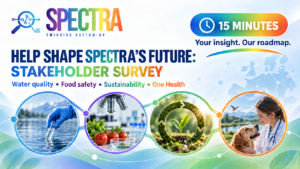
Stakeholder engagement remains a priority. A hybrid outreach workshop focusing on food authenticity using ion mobility techniques is planned for 26 November 2026 in Greece. A further stakeholder event is being considered for December, with its date and programme still to be confirmed.
As SPECTRA works towards its expected completion in September 2027, the meeting identified opportunities to strengthen the remaining research and build connections that could support future cooperation.
The SPECTRA team thanks External Advisory Board members Prof Dr Paola Calza and Dr Georgia Seretoudi for their expertise and constructive input, and all participants for contributing to the discussion.